
For startup and established detailers
Use it for a mobile, shop, or hybrid business, one service at a time.
Free four-page business worksheet
Calculate what one detailing service should cost based on labor, materials, travel, overhead, selling costs, and a target operating margin.
PDF · US Letter · 4 pages · DSPW-1.0 · No email, account, or customer data required
Four-page preview
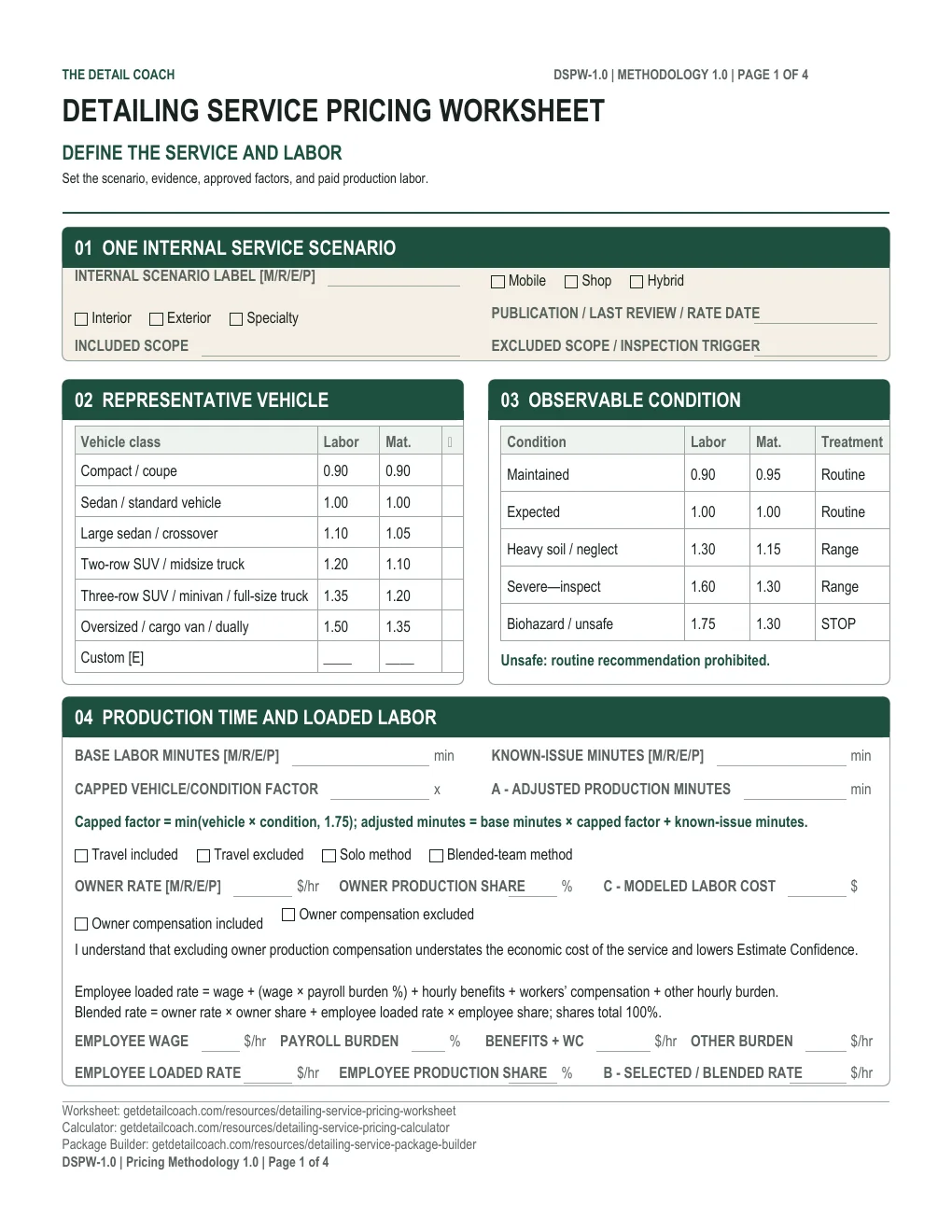
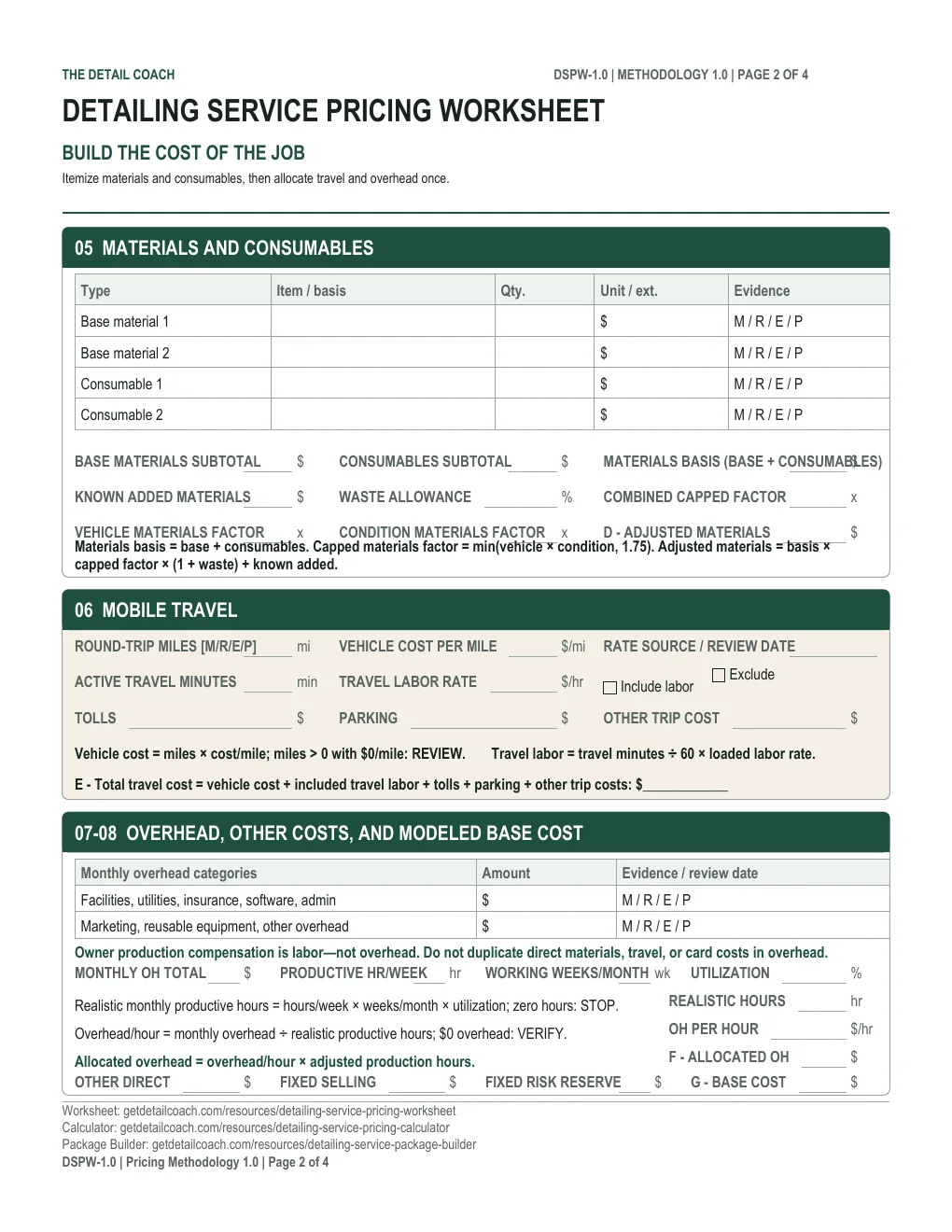
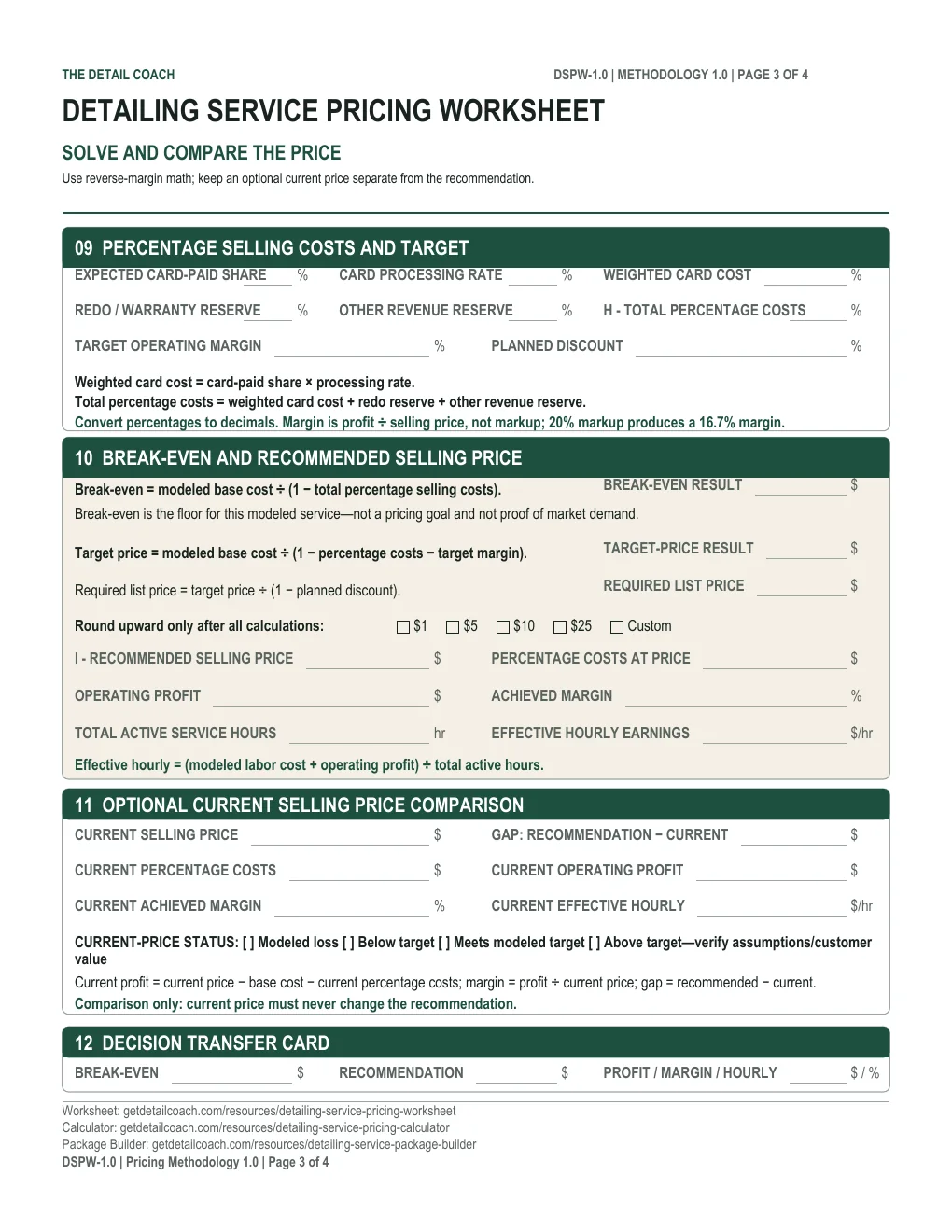
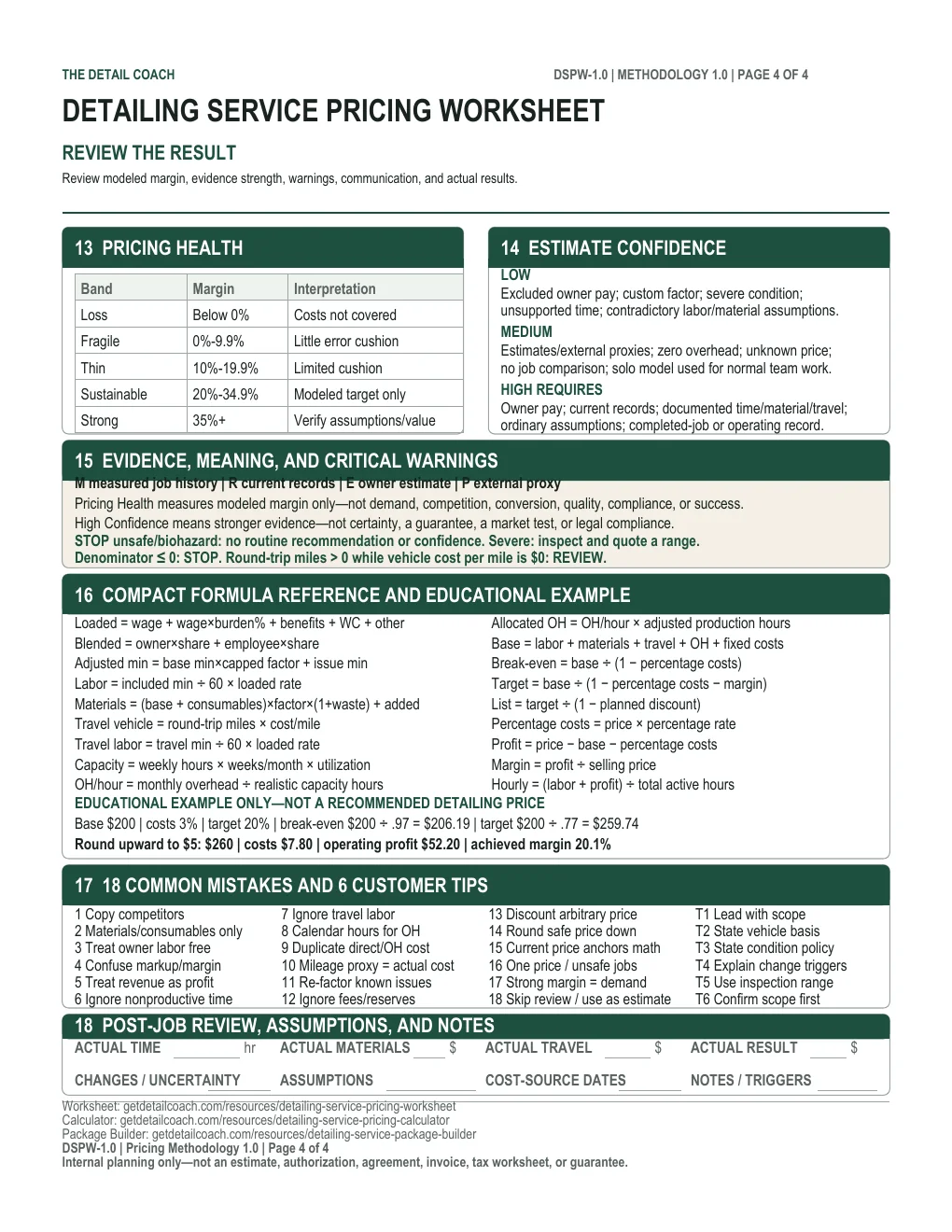
What it calculates
A sustainable service price must recover production compensation, materials and consumables, travel, productive-hour overhead, fixed job costs, and percentage selling costs before operating profit remains.
Use it for a mobile, shop, or hybrid business, one service at a time.
It is not a customer estimate, agreement, authorization, invoice, tax worksheet, or bookkeeping system.
Mark measured records, current quotes, external proxies, owner estimates, or planning goals so confidence is not confused with margin.
Severe condition needs inspection guidance. Potential biohazard or unsafe work receives no routine recommendation.
Nine-step workflow
Define one service scenario and its included and excluded scope.
Choose the representative vehicle and observable condition.
Estimate labor, record evidence, and include owner production compensation.
Adjust materials and consumables without duplicating costs.
Calculate travel time, vehicle cost, and other trip costs separately.
Allocate monthly overhead through realistic productive hours.
Use reverse-margin pricing to solve break-even and target price.
Compare the recommendation with the current price without changing it.
Review Pricing Health, Estimate Confidence, warnings, and post-job actuals.
Margin is not markup
Adding 20% to cost creates a markup, not a 20% selling-price margin. The worksheet keeps payment fees and other revenue-based reserves in the same denominator, reverses a planned discount before rounding, and rounds only upward.
Separate labor and material factors reflect differences in time and product use. Combined automatic factors are capped at 1.75. Known-issue labor and materials are added after the factors.
Pricing Health evaluates modeled margin only. Estimate Confidence evaluates the quality and completeness of the assumptions. Neither predicts demand, conversion, compliance, or success.
Review the result
Low: material gaps, excluded owner pay, custom factors, severe condition, or unsupported time.
Medium: estimates or proxies, zero overhead, unknown current price, or no completed-job review.
High: current records, documented time and costs, ordinary assumptions, owner pay, and completed-job evidence.
When the live tool is better
The printable worksheet is best for offline planning, team review, and a written assumption record. The live calculator automatically handles arithmetic, warnings, add-ons, specialty logic, fleet inputs, monthly projections, and capacity analysis.
Open the Detailing Service Pricing CalculatorDownload and print
Open the PDF and choose Print or Save as PDF. Use US Letter, portrait, one-sided, grayscale or black-and-white, and Actual size or 100%. If an edge clips, use Fit to printable area. Do not use multiple pages per sheet.
Open the PDF, choose Share, then Print; or choose Save to Files for later. Confirm US Letter, one-sided output, and all four page previews. Do not combine multiple pages on one sheet.
Open the PDF, use the viewer menu or Share, then select Print or Save as PDF. Confirm US Letter, portrait, one-sided, grayscale if preferred, and all four pages at full-page scale.
Black-and-white friendly · Static PDF · No fillable fields · No scripts · No tracking
Questions before using it
Yes. Download it directly without an email address, account, login, checkout, or expiring link.
No. DSPW-1.0 is a static worksheet designed for a pen and basic calculator. Use the live Pricing Calculator when automatic calculations or advanced scenario testing would help.
Operating margin is measured against the selling price. Reverse-margin pricing keeps the target margin and percentage selling costs in the denominator so the modeled price can recover both.
No. The worksheet begins with your labor, materials, travel, overhead, selling costs, and margin. Market research can help position an offer, but it does not prove another business is profitable.
No. It is an internal planning worksheet. Use separate customer-facing estimates, agreements, work authorizations, and invoices appropriate for the business and jurisdiction.
Version history
Published and last reviewed July 31, 2026. Compatible with Detailing Service Pricing Methodology 1.0. Rate references should be reviewed before each use.
Methodology and sources
The worksheet follows the same Detailing Service Pricing Methodology 1.0 used by the live calculator. Planning references include the U.S. Small Business Administration break-even guidance and the IRS standard mileage-rate reference, reviewed July 31, 2026. The mileage rate is a planning proxy, not a claim that it equals every operator’s actual vehicle cost.
Ready to work through the price?
Educational internal business-planning resource only. It is not legal, tax, accounting, insurance, employment, environmental, pricing, or financial advice and does not guarantee demand, margin, compliance, or business results.